Business Analytics & Entrepreneurship student building a finance-and-data-driven professional brand at the University of Arizona.

I'm a Business Analytics and Entrepreneurship student in the Honors program at the University of Arizona's Eller College of Management, graduating in May 2028. My coursework pairs a quantitative core with minors in Personal & Family Financial Planning and Global Business, reflecting a consistent interest in turning data into decisions people can actually act on. Whether I'm reconciling a chapter budget or reading an assessment chart, I'm looking for the same thing: a clear, evidence-backed story underneath the numbers.
That instinct took shape outside the classroom as much as inside it. As VP of Finance for Beta Theta Pi, I managed chapter budgets, dues collection, and expense approvals, and learned to translate financial oversight into guidance an executive board could act on. As UArizona Relations Manager for TAMID Group, I supported consulting projects and kept outreach aligned with university requirements, while ongoing volunteer work with Be My Eyes sharpened the kind of clear, real-time communication no classroom assignment can teach. Together, these experiences point toward the same place: the intersection of analytics, finance, and entrepreneurship, where I want to use data not just to explain what happened, but to make the case for what to do next.
My work environment preferences point to a values profile built around open debate and relationship investment — not formal hierarchy or conflict avoidance.
My Self-Perception Inventory's Work Environment Preferences (WEP) scores the highest on Debate (3.67) and Relationships (3.00), moderate on Decision-Making (2.00) and Chronemics (1.33), and near-zero on Conflict (0.00), Feedback (0.00), and Hierarchy (1.00). My preferred team role is Innovation, and my strongest motivators are Social Interest and Financial Interest.
These scores show I'm energized by direct, idea-driven discussion and genuine connection rather than status-based process — I'd rather debate an idea openly and build relationships along the way than wait for formal feedback channels or hierarchy to dictate how a decision gets made. Brand strategy: I should position myself as someone who builds consensus through open debate, not someone who needs rigid structure to contribute.
I'm more proactive and self-confident in others' eyes than in my own self-assessment, while my identity as a problem-solver is something both perspectives agree on.
My Self-Perception Inventory places me at Proactivity 1.0 / Reactivity -2.0; my Professional Reputation Survey (6 respondents) places me at Proactivity 7.7 / Reactivity -1.3 — both land in "Driver" territory, but the gap in degree is large. "Problem-Solver" and "Entertaining" appear in both my self-rated adjectives and my most-mentioned reputation adjectives, but "Self-Confident" was the single most-mentioned trait by others (5 of 6 respondents) despite not appearing in my own top SPI list, while "Caring" and "Well-Rounded" are self-identified traits that don't surface as often in outside feedback.
This gap suggests I tend to undersell my own assertiveness — the confidence and drive my network already sees in me hasn't fully registered in how I describe myself. Brand strategy: claim proactivity and confidence explicitly in interviews and applications rather than hedging, since the data shows others already extend me that credit; at the same time, make the relationship-building and depth I value more visible in my work, since that side hasn't shown up as strongly in outside feedback yet.
I'm a reliable, engaged presence on every team I join, but my 360° feedback points to a specific growth edge: moving from surface-level contribution to deeper analysis.
My 360° evaluation places my average team contribution score at 4, against a team-high average of 6. The PRS qualitative feedback from 6 respondents reinforces this pattern: reviewers consistently highlight reliability and drive — one calls me "consistently reliable and willing to show up when others do not," another cites my "eagerness to get tasks done" and "always generating ideas." At the same time, multiple reviewers flag the same growth edge around depth and delivery — one notes I could "engage in content deeper rather than surface level analysis" and "sometimes struggles to apply feedback in a short span of time," while others add that my directness can "come across as dismissive or unapproachable" and that I should "focus on developing thoughtful, methodical strategies that align with the team's objectives" before moving to solutions.
Read together, this isn't a motivation problem — it's a depth and pacing problem. I show up and move fast, but my teammates are telling me to slow down enough to go deeper before moving on, and to close the loop on feedback faster once I get it. Brand strategy: in team settings, I want to be known not just for showing up and driving toward completion, but for pressure-testing ideas before I act on them — and for visibly closing the loop when a teammate gives me feedback, rather than letting it register only eventually.
My brand strategy is to own the "confident, driven problem-solver" identity my network already extends me — which aligns directly with the keywords my Radian brand analysis surfaced (ambitious, data-driven, strategist, poised, leadership) — while using this site itself as the proof point for the relationship-building and depth that hasn't fully registered yet. Concretely, my next steps are: (1) write my bio and portfolio captions to foreground relationship-building and depth, not just outcomes; (2) ask for feedback after collaborative work specifically on tone and pacing, so directness doesn't read as dismissiveness and feedback gets applied visibly, not just eventually; and (3) keep claiming proactivity and confidence explicitly in interviews and applications, since I tend to undersell exactly the trait my network rates highest.

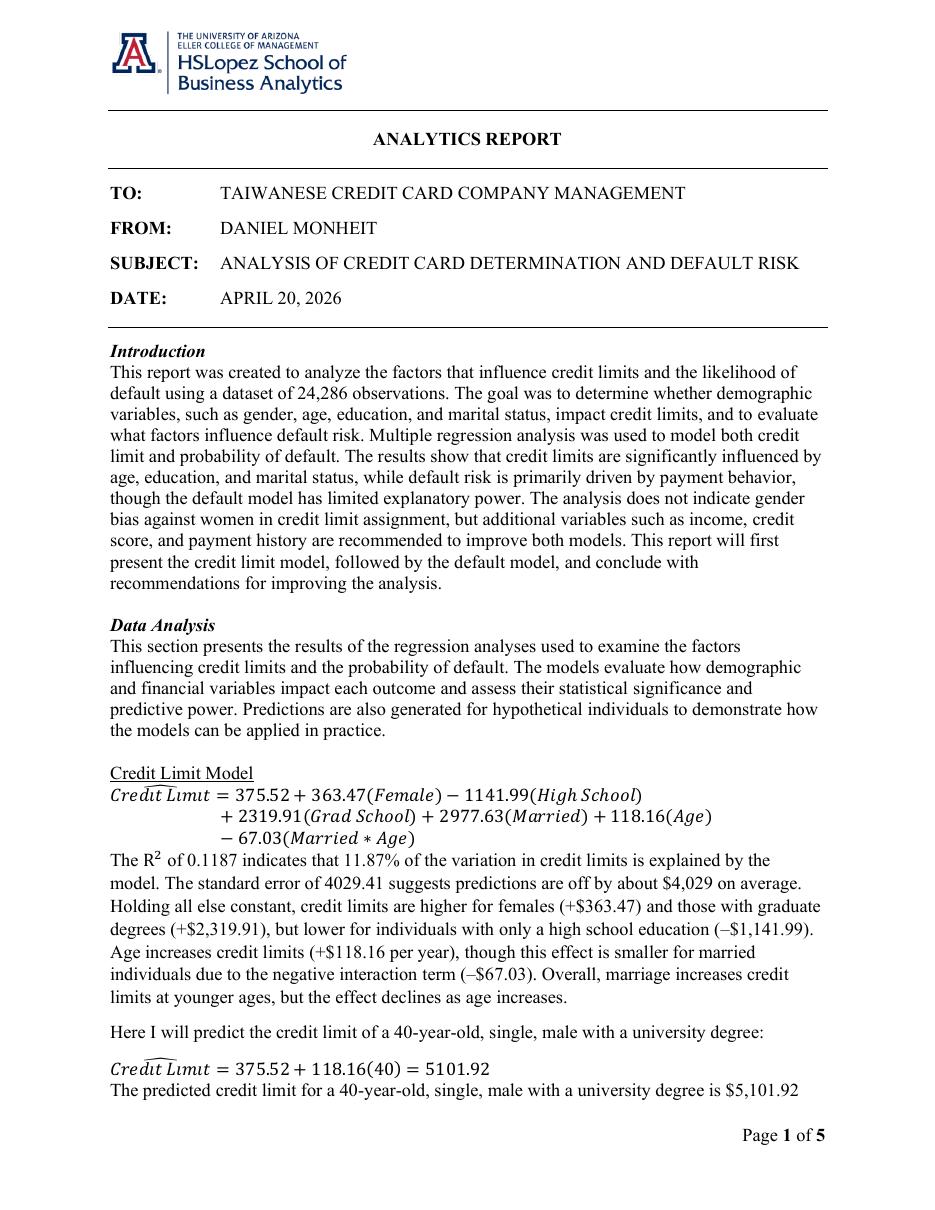
An analytics report for an Eller business analytics course, written as a memo to a hypothetical Taiwanese credit card company, modeling what drives credit limit assignment and default risk across 24,286 customer records.
Multiple regression modeling, hypothesis-driven business writing, and translating statistical output — coefficients, R², p-values — into a plain-language recommendation a non-technical executive could act on.
This is the clearest proof of the "data into decisions" identity I claim in my bio, and it sits directly on the finance side of my major. It also shows judgment, not just modeling: I flagged the default model's weak explanatory power (R² = 0.015) instead of overselling a result that didn't hold up.
Download PDF →
A pitch deck I co-built with Teddy Sye for ClassCompass, a non-profit concept that helps undergrads choose classes and manage workload through smart scheduling and grade forecasting.
Product thinking, target-market definition, and team collaboration — structuring an idea into vision/mission, target demographic, product mechanics, and a financial model as a two-person founding team.
This is the direct evidence for my Entrepreneurship major and the one piece in this portfolio that shows I can build with a partner, not just analyze solo — which matters given my CER analysis shows relationship-building is the side of my brand that needs more visible proof.
Download PDF →
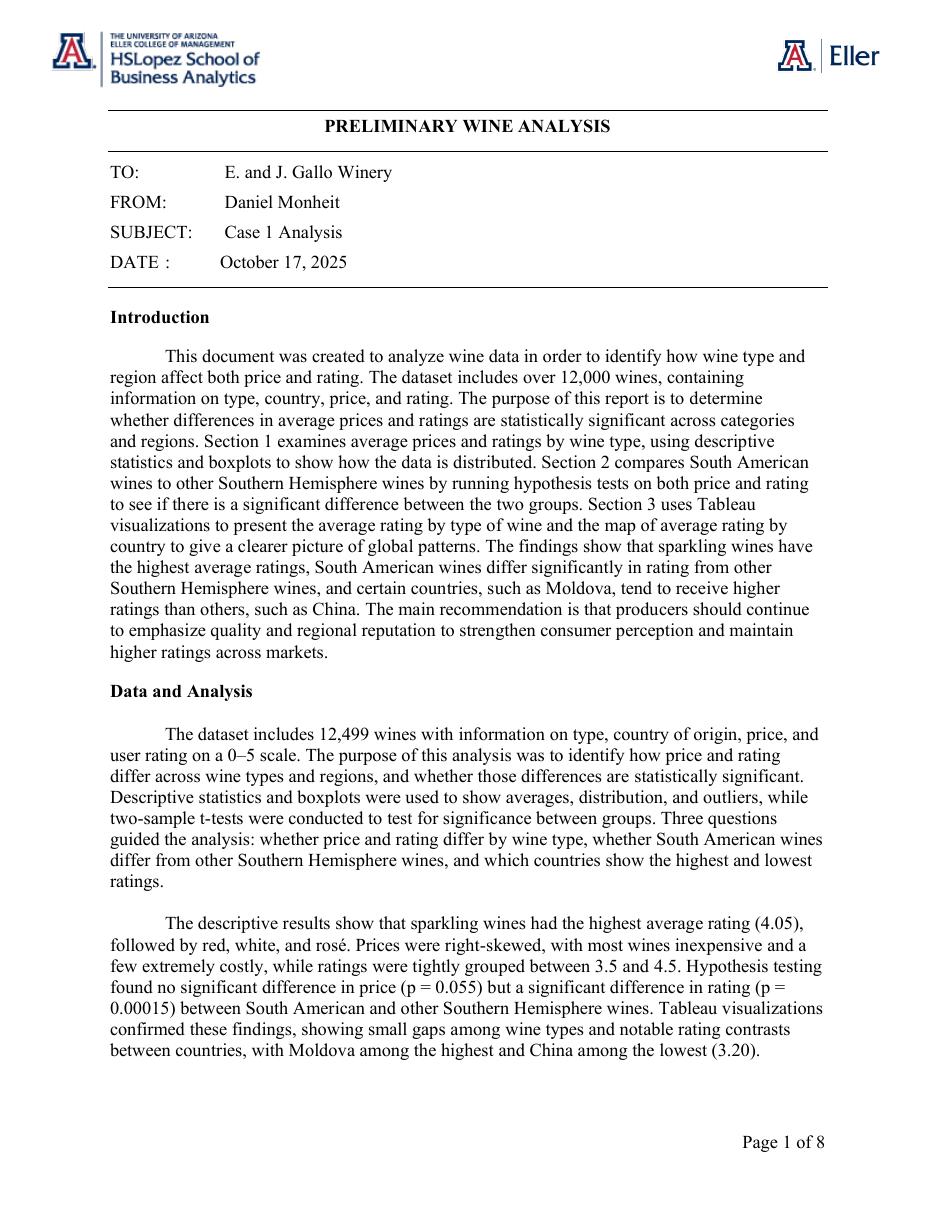
A business analytics memo for E. & J. Gallo Winery, analyzing over 12,000 wines to determine how type and region affect price and consumer rating.
Descriptive statistics, two-sample hypothesis testing, and Tableau visualization, used to turn a raw dataset into clear, evidence-based recommendations for a business audience.
Where the credit risk report demonstrates regression modeling, this one shows a different part of the toolkit — hypothesis testing and visual storytelling — proving range across analytical methods while staying consistent with the same throughline: looking for the evidence-backed story underneath the numbers.
Download PDF →